Most surety bonds, including license and permit, commercial, and court bonds, must be renewed to stay in effect, even when the bond form describes the bond as “continuous.” Because your license, permit, or other requirement often depends on an active bond, a missed renewal can put you out of compliance.
At American Surety Bonds Agency, we handle every renewal for our clients directly, from the renewal invoice to the documents your obligee may ask for. This guide explains how surety bond renewal works, what your obligee may require, and how to keep your bond in good standing.
Do Surety Bonds Expire?
Most surety bonds have a set term, and a renewal premium is due at the end of each term to keep the bond in force. Depending on the bond, the renewal date may be the bond’s own anniversary date or a common date set by the obligee, such as a license renewal deadline.
Many bond forms call the bond “continuous.” However, that word only means the form has no printed expiration date. It does not mean the bond stays in effect without payment. If the renewal premium goes unpaid, the surety can cancel the bond by sending written notice to the obligee. The cancellation takes effect after the notice period set in the bond form.
Surety Bond Renewal Types
Depending on the bond and the obligee, your bond will usually renew in one of four ways:
- Non-renewing bond: the bond covers a single event or a fixed term and then ends.
- Continuous bond: the bond stays in force as long as you pay the renewal premium, with no new bond to file.
- Continuation certificate: after you pay, the surety confirms in writing that the bond remains in force for the new term.
- Renewal bond: some obligees require a new bond each term, so a new bond is issued for you to file.
For continuous and continuation certificate bonds, we send you a continuation certificate and a paid invoice once you pay your renewal invoice. That way, you always have proof of renewal for your files or your obligee. Non-renewing bonds work differently.
A title bond, for example, is paid for once and covers a set term, often three years. When that term ends, the bond expires and does not renew. Notary bonds follow a similar pattern: the premium covers your full commission term, and when you renew your commission, you obtain a new bond.
What About Court and Contract Bonds?
Court bonds, such as probate or guardianship bonds, usually renew each year until the court releases them. To end the bond, you need a release document from the court, such as a final order or judgment, before the surety will cancel it.
Contract bonds, such as performance and payment bonds, usually have a one-time premium paid when the bond is issued. They stay in force until the project is complete and the obligee releases the bond.
Bond Renewal Dates vs. Obligee Deadlines
Your bond’s renewal date and your obligee’s deadlines are related, but they do not always fall on the same date. For example, a bond may renew on its own anniversary date, while a license or permit renews on a date the obligee sets for every holder.
Obligees also set their own deadlines for proof of renewal. Some require evidence of a renewed bond 60 to 90 days before the bond expires, others ask for it 30 days before, and some accept it up until the expiration date. Because these rules vary, review your bond form and your obligee’s renewal instructions so you know exactly what to submit and when.
Can Your Renewal Premium Change?
Yes. At renewal, we pull a new credit report and may ask for updated financial statements or other underwriting information. As a result, your renewal premium may go up or down from your last term.
Your premium can also change when the obligee changes the bond requirement. For example, if the obligee raises the required bond amount, the premium for the larger bond will be higher.
What Happens If You Don’t Renew Your Bond?
If you do not pay the renewal premium, the surety can cancel the bond by notifying the obligee. Once the obligee receives that notice, your license, permit, or other requirement may be at risk until a new bond is in place.
Whether a canceled bond can be reinstated is up to the surety, so contact us right away if you missed your renewal. To avoid a lapse, pay your renewal invoice as soon as you receive it, and then send any required proof of renewal to your obligee before its deadline.
How to Renew Your Bond With American Surety Bonds Agency
We manage the renewal process from start to finish. Here is how it works:
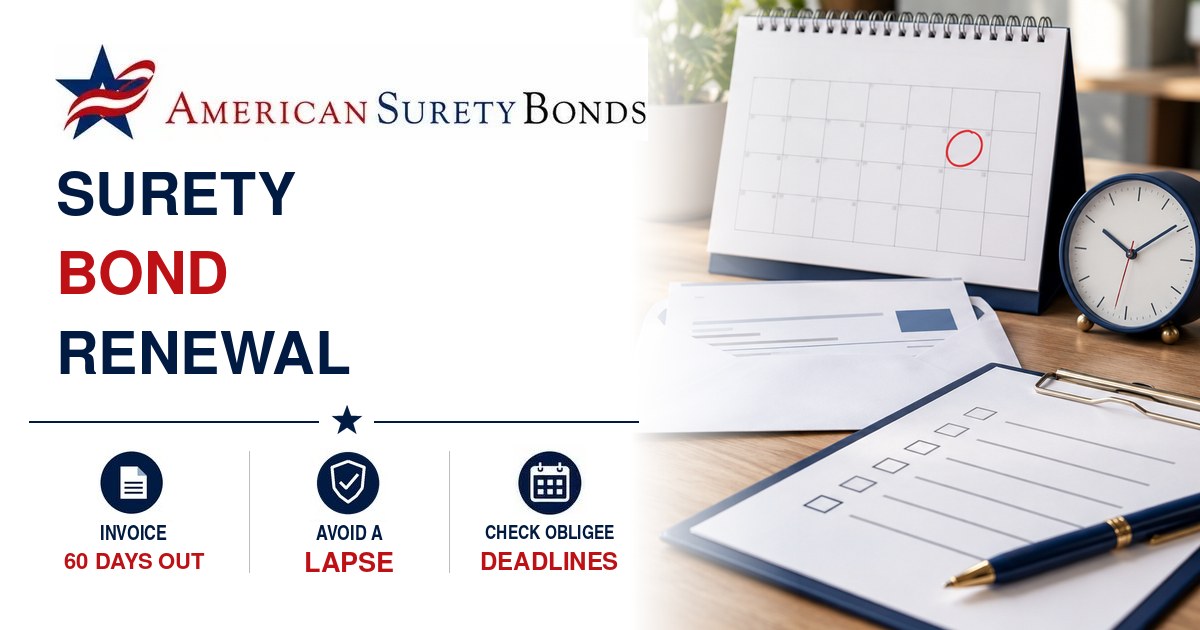
- We mail your renewal invoice at the end of the month, about 60 days before your bond expires.
- You pay the renewal invoice. If the surety needs updated underwriting information, we will let you know.
- After your payment, we send your continuation certificate, or a new bond if your obligee requires one, along with your paid invoice.
- Finally, if your obligee requires proof of renewal, you send it before the obligee’s deadline.
If you have questions about your renewal or your obligee’s requirements, our team is here to help.
Frequently Asked Questions
| Do surety bonds expire? | Most do, including license and permit, commercial, and court bonds. A renewal premium is due each term to keep the bond in force, even when the bond form describes the bond as “continuous.” Some bonds, such as title bonds, are paid for once, cover a set term, and do not renew. |
| What is a continuation certificate? | A continuation certificate is a document from the surety confirming that your existing bond remains in force for another term. We send it to you, along with your paid invoice, after you pay your renewal. |
| When will I receive my renewal invoice? | We mail renewal invoices at the end of the month, about 60 days before your bond expires. |
| When does my obligee need proof of renewal? | It depends on the obligee. Some require proof 60 to 90 days before the bond expires, some 30 days before, and others accept it up until the expiration date. |
| Can my renewal premium change? | Yes. We pull a new credit report at renewal and may ask for updated financial information, so your premium may go up or down. It can also change if the obligee raises or lowers the required bond amount. |
| What happens if I don’t pay my renewal premium? | The surety can cancel the bond by notifying the obligee, which may put your license, permit, or other requirement at risk. Whether a canceled bond can be reinstated is up to the surety. |
| What if I no longer need my bond? | Contact us before your renewal date. Some bonds can be canceled with notice to the obligee, while court and contract bonds stay in force until the court or obligee formally releases them. |
Keep Your Bond in Good Standing
Renewing on time keeps your bond active and your license, permit, or other requirement in good standing. If you need a new bond or have a question about an upcoming renewal, explore the bonds we offer in your state or contact our team.
Ready to Get Started?
Complete our simple online application, or speak with one of our surety specialists today.
American Surety Bonds Agency proudly serves businesses nationwide with fast approvals, competitive rates, and responsive service.
Let American Surety Help!
Have Questions?
American Surety Bonds Agency
138 Hammond Drive, Suite B, Atlanta, GA 30328
(404) 486-2355
Monday to Friday, 8 AM to 6 PM